What to Expect in a Session
Each session lasts ~70 minutes total: 8 minutes to gently pressurize, 20 minutes of therapeutic immersion, and 8 minutes to depressurize, and repeat for a total of 2 cycles (2nd pressurization takes about 5 minutes). Relax in the chamber's bright, open interior with large viewports for natural light—no claustrophobia here! Ambient air keeps things simple and safe. Bring a book, meditate, or nap—many clients call it their "productive downtime."
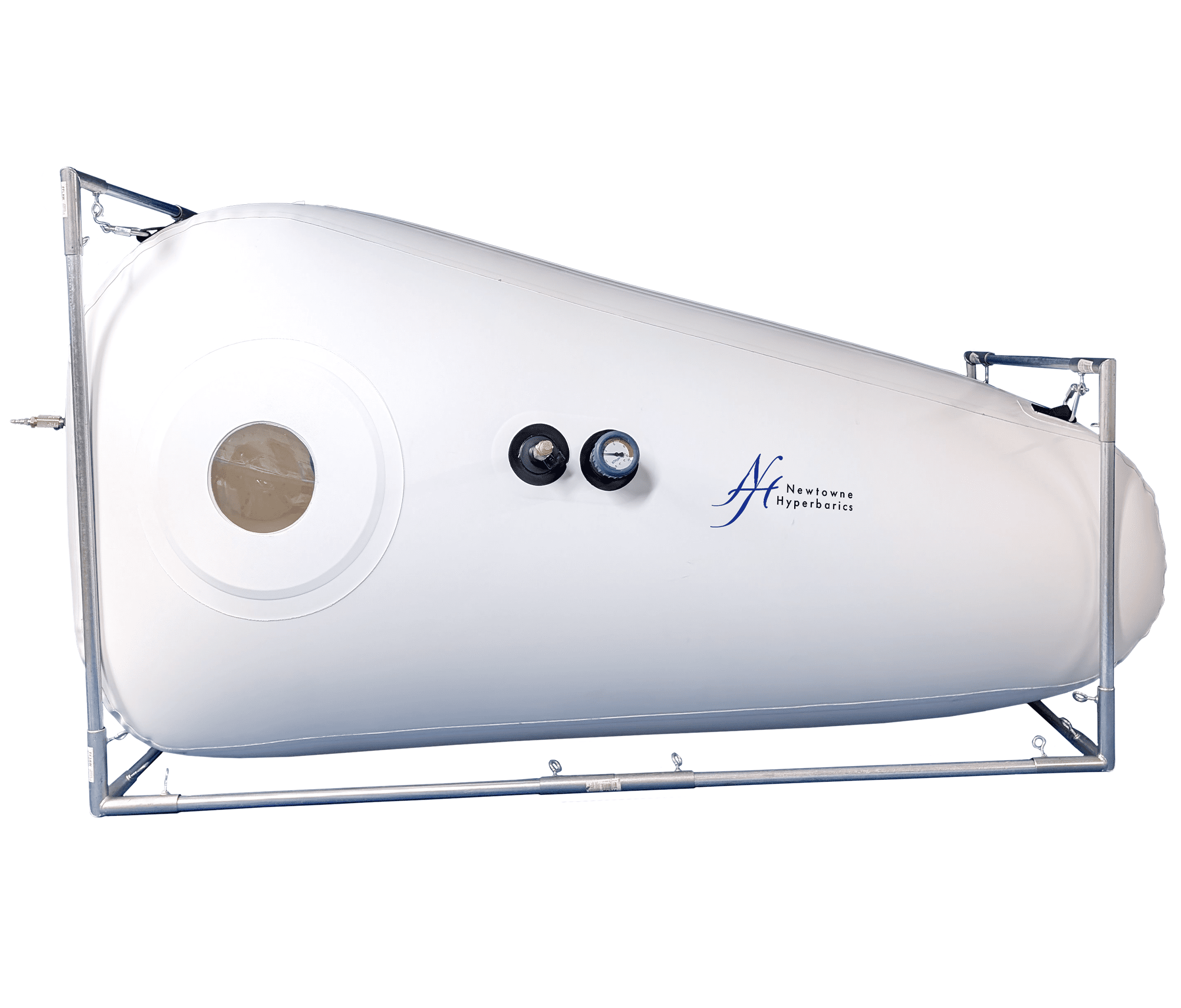
About the Newtowne Hyperbaric Long Shoe Chamber
Handcrafted in the USA by Newtowne Hyperbariatrics (leaders in hyperbaric innovation for 20+ years), this premium soft-shell chamber is designed for ultimate comfort and safety:
- Spacious Dimensions: 81" long x 37" wide x 42" high—perfect for taller users (up to 6'2") to lie flat or sit up fully.
- Medical-Grade Build: Double-laminated ballistic nylon with hypoallergenic urethane coating for durability and easy cleaning.
- Advanced Safety: Dual redundant pressure relief valves, override compressor protection, and the world's strongest coil zipper system. 100% safety record since 2001; FDA-registered (#K051759).
- User-Friendly: Two large viewports and able to depressurize from inside.
🩺 Our Standard 70-Minute Session Protocol (1.3 ATA)
| Stage | Duration | Chamber Pressure | Key Physiological Actions |
|---|---|---|---|
| 1. Pressurization (Acclimation) | 8 min | Gradual ramp from 1.0 → 1.3 ATA | Equalize ears frequently; sympathetic activation; increased plasma O₂ concentration begins |
| 2. Steady State (Therapeutic Hold) | 20 min | Maintain at 1.3 ATA | “Oxygen loading” phase. Plasma O₂ rises ≈ 35–40 % (Hyperoxygenation of plasma). Mitochondria boost ATP output. Mitochondrial respiration upregulation; stem-cell signaling by 2.5-3% increase (CD34⁺ mobilization); reduced inflammation (NF-κB modulation) |
| 3. Mid-Pressure Dip | approx. 5 min | Gradual ramp from 1.3 → 1.2 (or 1.1) ATA | Controlled “oxygen valley.” Triggers HIF-1α, VEGF, and mild hormetic adaptation. (1.2 ATA = 20-25% increase in Plasma Oxygenation, 1.1 ATA = about 10-12% increase over 1.0 ATA), mitochondria sense the decreased O₂ and become more efficient, nervous system experiences a small parasympathetic boost, improving relaxation and vagal tone. |
| 4. Re-pressurization | 2-3 minutes | Gradual ramp from 1.2 (1.1) → 1.3 ATA | “Re-oxygenation” wave. Reinforces nitric-oxide signaling and antioxidant response. |
| 5. Steady State #2 | 20 min | Maintain at 1.3 ATA | Triggers another wave of nitric oxide and antioxidant enzyme release; Hyperoxygenation of plasma; reinforces mitochondrial biogenesis and microvascular adaptation; stem-cell signaling by 2.5-3% increase (CD34⁺ mobilization); reduced inflammation (NF-κB modulation) |
| 6. Decompression #2 | 5-9 minutes | Gradual ramp from 1.3 → 1.0 ATA | Most therapeutic effects peak here: enhanced oxygen off-loading, vascular dilation, nitric oxide release, and antioxidant enzyme induction (SOD, catalase) |
| 7. Recovery / Integration | Optional 5–10 min outside | – | Encourage hydration, slow movement, integration of experience; may combine with grounding or gentle breathing techniques |
🧬 Why Decompression Is So Important
Oxygen Gradient Shift: As pressure drops, oxygen partial pressure in tissues exceeds capillary levels — oxygen diffuses more effectively into hypoxic or inflamed tissues.
Nitric Oxide (NO) Cascade: NO release during decompression promotes vasodilation and mitochondrial biogenesis.
Reactive Oxygen Species (ROS) Signaling: Brief, mild ROS increase triggers antioxidant enzyme upregulation (hormetic response).
Improved Lymphatic Flow: The alternating compression–decompression acts like a “massage” for interstitial fluid dynamics.
🌿 Phase 2 – Drop to 1.2 or 1.1 ATA (Controlled “Oxygen Dip”)
This slight reduction in oxygen partial pressure mimics mild intermittent hypoxia.
The shift activates HIF-1α, VEGF, and EPO gene expression — improving angiogenesis, circulation, and stem cell signaling.
It acts as a metabolic reset: mitochondria sense the decreased O₂ and become more efficient.
The nervous system experiences a small parasympathetic boost, improving relaxation and vagal tone.
- Creates a "metabolic workout".
-> Likely Benefits of This Pressure Cycling
| Category | Benefit | Mechanism |
|---|---|---|
| Mitochondrial Function | Improved ATP efficiency and biogenesis | Alternating oxygen loads challenge mitochondria like interval training |
| Vascular Health | Enhanced angiogenesis and endothelial flexibility | Repeated HIF/NO stimulation |
| Inflammation Modulation | Stronger antioxidant response | Repeated ROS signaling trains antioxidant enzymes (SOD, catalase) |
| Neural & Cognitive | Better neuroplasticity and oxygen utilization | Cyclic oxygenation mimics “brain interval training” |
| Lymphatic & Detox | More rhythmic pressure gradient improves fluid exchange | Pressure shifts mobilize interstitial fluid |
| Stress Resilience | Parasympathetic activation & hormetic adaptation | Controlled “stress–relax” rhythm balances ANS tone |
🧬 What Happens During Full Decompression
As you begin returning from 1.3 ATA to 1.0 ATA:
Oxygen partial pressure (pO₂) in the plasma and tissues starts to fall.
This creates a steep oxygen gradient — driving O₂ out of the plasma and into cells and mitochondria.
At the same time, nitric oxide (NO) signaling increases, causing microvascular dilation and improved perfusion.
Mild reactive oxygen species (ROS) are generated transiently, which trigger antioxidant enzyme expression (SOD, catalase, glutathione peroxidase).
The process also activates hypoxia-inducible factors (HIF-1α), which promote stem cell signaling, angiogenesis, and mitochondrial biogenesis.
So, decompression isn’t just “ending the session” — it’s the integration phase where your body puts the oxygen to use and begins adaptive repair.
Is mHBOT Safe for You?
mHBOT is safe for most, but certain conditions require caution.
- Absolute contraindications: untreated collapsed lung, active seizures, specific chemotherapies (e.g., Bleomycin), recent organ transplant.
- Relative contraindications: pregnancy, COPD/asthma (in some cases), claustrophobia, or recent ear/thoracic surgery — consult your physician.
Contact us with questions!
✳ Pricing & Packages
Invest in your wellness with flexible options. Research shows mHBOT is most effective with 10+ sessions, with many protocols recommending 40 sessions (often twice daily) for optimal results. Choose the plan that fits your goals:
Single Session: Normally $140, currently $80 – Perfect for trying mHBOT or occasional boosts.
10-Session Package: $700 ($70/session, save 50%) – Ideal for consistent recovery. Use within 1 month.
40-Session Package: $2,400 ($60/session, save 57%) – Best value for transformative wellness. Use within 2 months.
Packages are non-refundable but transferable.
Prepaid packages can be purchased online at: https://bookeo.com/psinergyhealth/prepaid or by stopping in our office.