Why Work With a Natural Health Professional?
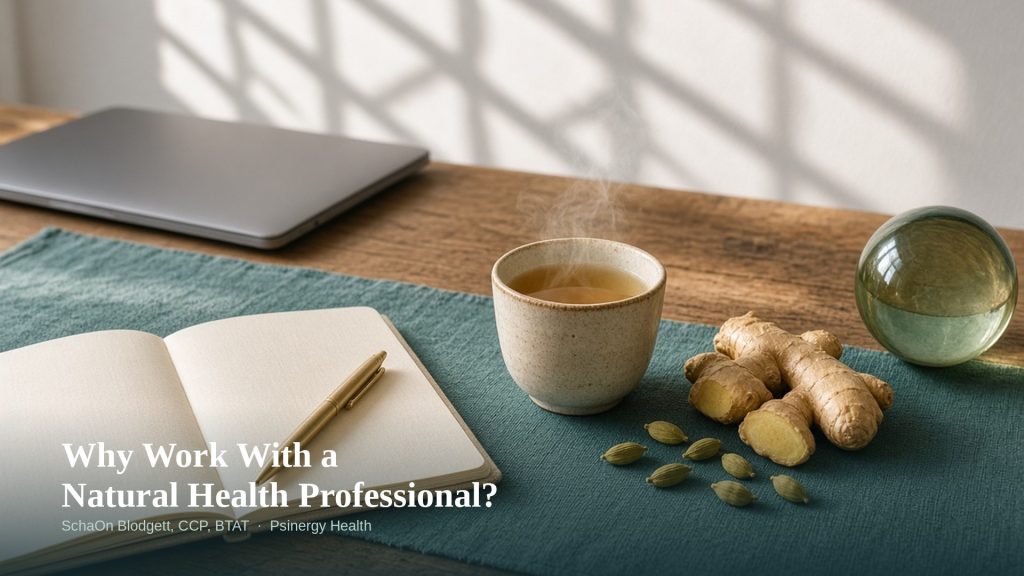
Let’s be honest: you can find almost anything online these days. Herbs for sleep, teas for digestion, which essential oil to diffuse for stress. A quick search turns up hundreds of articles, videos, and forum threads, and plenty of that information is good. I’m glad it’s out there.
So why would anyone still work with a natural health professional? The short answer is that information isn’t the same thing as insight. Knowing what an herb does is one thing. Knowing whether it’s right for you, right now, is something else entirely.
If you are earlier in the process, and the question is still how to tell a careful practitioner from a careless one, I wrote that up separately: How to Choose a Natural Health Practitioner. This piece is the other half. Not how to check someone. This one is about why you would sit down with someone at all.
One herb, a thousand dis-eases
There’s a saying in Ayurveda that I come back to again and again: “One herb can address a thousand dis-eases, and one dis-ease can be addressed by a thousand herbs.”
At first it sounds like a riddle. But it’s really a statement about the individual. Take ginger as an example. For one person it’s exactly what a sluggish, cold digestive system has been asking for. For another person, someone already running hot and irritable, it may simply add fuel to the fire. Same herb, very different result.
It works the other way, too. Two people can walk in with what looks like the same complaint, say, trouble sleeping. One is wired and anxious, the other is depleted and heavy. On paper it’s the same “problem.” In practice, it calls for two completely different approaches.
This principle shows up across the natural health world, not just with herbs. Homeopathy is a great example. In classical homeopathy, the remedy is matched to the whole person, not just the complaint, so two people with the “same” issue may need entirely different remedies. Complex Homeopathy, which combines several remedies into one formula, tends to be more forgiving in that regard, as do lower potencies like 6C, 12C, or 30C. Even so, knowing which approach fits which person is where experience comes in.
That’s the heart of it: you are as unique as your fingerprint. There are common threads among all of us, of course, but your constitution, your history, your stresses, and your current state of balance are yours alone. An online list of “top 10 herbs for insomnia” can’t see any of that. It treats everyone as the same person.

One herb, a thousand dis-eases. Ginger in the center, and a few of the thousand others around it.
Information vs. interpretation
Much of mainstream health advice is built on large studies that average results across thousands of people. That has its uses, but an average person doesn’t actually exist. You aren’t a statistic. You’re a whole, living system: body, mind, emotions, environment, and history all interacting at once.
In holistic work, we often talk about the terrain, the inner environment that determines how well you adapt, recover, and stay in balance. The terrain view doesn’t ignore germs or symptoms; it widens the lens to ask why this person, why now, and what their system needs to come back into balance. Basically, what is allowing that invader to take hold in your system in the first place?
Detoxing is a perfect example of why this matters. Someone may read about a popular detox and decide it’s exactly what they need. But if their system is already depleted, a detox can weaken them further and do more harm than good. Sometimes the body needs to build strength first. Other times, a gentle approach is the wiser choice, like a few days of simple, nourishing Kitchari, a traditional Ayurvedic dish of rice and mung beans that gives digestion a rest without stripping the body down.
That’s where a trained practitioner earns their keep. We’re not just handing out information. We’re listening for patterns, noticing what you don’t say, connecting the stress at work to the digestion to the sleep, and asking the questions a search engine never will. Then we help you sort through the noise, so you’re not stuck trying fifteen different supplements because fifteen different websites said so.
Seeing your blind spots
We all have them: the areas of our lives we don’t look at too closely. Sometimes we avoid them on purpose, because they’re uncomfortable. Sometimes we don’t even realize they’re there. Either way, it’s very hard to see your own patterns from the inside.
When you research on your own, you naturally focus on what you already believe is the problem. You search for the symptom you’re aware of, not the habit you’ve stopped noticing, the relationship that drains you, or the old emotional weight you’ve learned to carry without thinking about it. Yet those are often the very things holding the imbalance in place.
An experienced practitioner comes in with fresh eyes. We notice the topic you change the subject on, the pattern that keeps showing up, the connection you haven’t made yet. Modalities like Colorpuncture and BodyTalk are designed to bring underlying patterns to the surface, often ones the conscious mind has tucked away. This isn’t about judgment. It’s about gently shining a light where you haven’t been able to look, so real change can happen.
And yes, this applies to practitioners too. I work with other practitioners myself, because I’m well aware that I have my own blind spots. Sometimes I simply need a different perspective or a fresh point of view, and that’s something I can’t give myself. It’s one of the best things I do for my own well-being, and it makes me better at supporting yours.
Some things you can’t learn from a short video or article
You can read about herbs and try a few on your own. Some modalities, though, simply aren’t do-it-yourself. They take real training, hands-on practice, and years of refining your eye.
- Colorpuncture, part of Esogetic Holistic Medicine, applies specific colors of light to points and zones on the skin. Practitioners learn which points, which colors, in what sequence, and how to read the body’s response. Knowing that “red is warming” from a blog post doesn’t tell you how to build a session.
- Acupuncture is the licensed, needling relative of a related idea. It takes extensive training in point location, technique, and meridian theory, and it’s a licensed profession in most states. I don’t needle. I mention it because a video isn’t a qualification there either.
- Energetic and body-based modalities such as BodyTalk, Access Consciousness Bars, and Brainspotting each take dedicated training and hands-on practice to do well.
Beyond technique, a trained practitioner brings judgment: knowing which tool fits which person, when to go gently, and when something is outside their scope and calls for a referral. I refer to a physician, or to licensed mental health, as needed and when it is appropriate. I would rather you have both in your corner than treat this as an either/or.
A word about AI
These days, many people skip the search engine and go straight to AI. I think AI can be a wonderful tool. I use it myself. But it has a blind spot that’s worth understanding.
From my background with computers, there’s an old saying: “Garbage in, garbage out.” AI is only as good as what it draws from, and it can’t always tell a trustworthy source from a careless one. It also delivers a wrong answer with the same calm confidence as a right one.
Here’s a recent example. I had a client who was double-checking my recommendations with AI, which I loved. Being an informed, engaged client is a great thing. Then the AI told them to use a much larger amount of borax in a bath than I had suggested. When I looked into it, the AI had picked up a newly created, non-reputable website. The amount on that page was far beyond what I consider sensible for an external bath, and it could have harmed my client.
That’s the difference training makes. A practitioner who uses AI can usually spot when it’s pulling in garbage, because we know what a sensible amount looks like and we know which sources to trust. Someone without that background often has no way to tell. So by all means, use AI to learn and ask questions. Just don’t let it be the final word, especially on amounts and safety.
A partner, not a prescription
You change. The seasons change. What supported you in spring may not be what you need in the dry, cold months of a Minnesota winter. Working with a practitioner means someone is walking alongside you, noticing what’s shifting and adjusting the approach as you go.
Having someone in your corner who knows your story makes it much more likely those changes actually stick. That part is close to what a good health coach does. What a coaching call cannot do is the session itself, or the judgment about when the plan needs to change, or when the next step is a referral rather than another week of the same homework.
And it isn’t always about new insight. Sometimes the most valuable part of a session is simply being reminded of what you already know. Life gets busy, and the practices that once kept you grounded quietly slip away. A gentle reminder from someone who knows you can be just what you need to come back to yourself.

What fit in the green months may not be what a Minnesota winter asks for.
Where to start
By all means, keep reading, keep learning, keep asking questions. An informed client is my favorite kind of client. But when you’re ready to move from general information to something tailored to you, that’s where working with a natural health professional makes all the difference.
If you’d like to explore what that could look like, I invite you to book an Initial Discovery Session. We’ll talk about where you are, where you’d like to be, and which approaches might fit you best. If you are still deciding whether we are a fit, a free Exploratory Consult is the lighter door.
Disclaimer: SchaOn Blodgett, CCP, BTAT, is an unlicensed complementary and alternative health care practitioner under Minnesota Statute 146A. The services offered are not licensed by the state, and this content is for educational purposes only. It is not intended to diagnose, treat, cure, or prevent any disease, and it is not a substitute for care from a licensed health care provider.
Awarded Top 100 Holistic Health Blogs
Order Herbs & Supplements