Pumpkin Pie Spice Cravings & Traditional Parasite Herbs
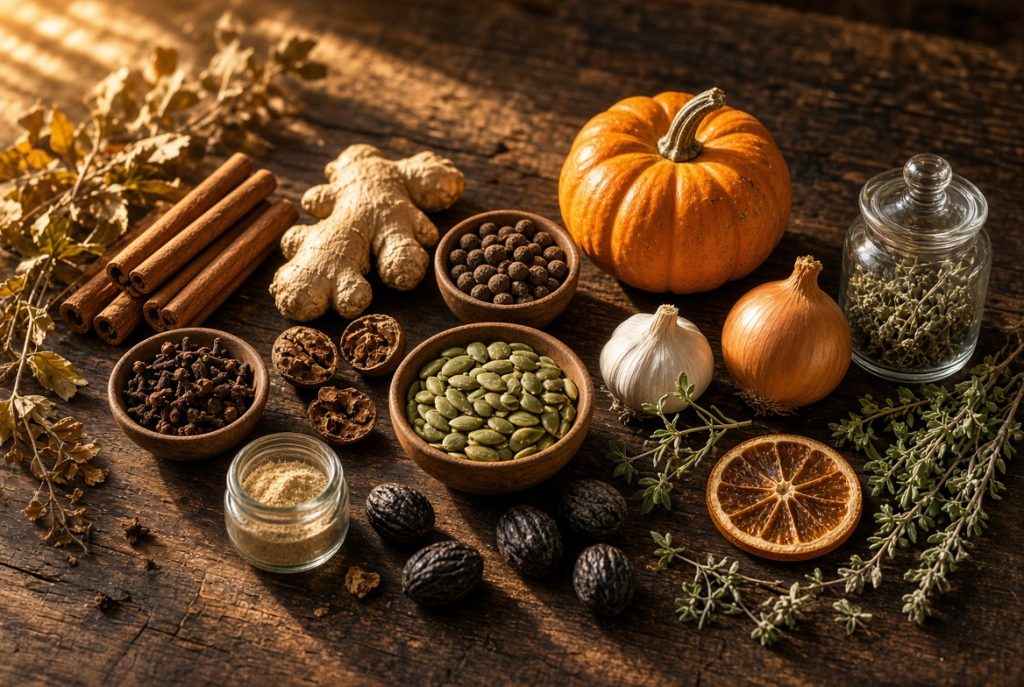
Every September the same smell walks into every coffee shop, candle aisle, and grocery end-cap: pumpkin pie spice.
There is no pumpkin in pumpkin pie spice. What you are actually craving is a short list of warming plants — cinnamon, ginger, nutmeg, allspice, cloves, and sometimes cardamom and mace.
Side note: Pumpkin itself does have its uses in the fall. According to Ayurveda, it helps thicken the skin to prepare us for the winter to come.
That list should look familiar if you have ever spent time in a traditional herbal materia medica.
I am not saying a latte means you have parasites. Cravings are not lab results. What I am saying is this: the body often reaches for flavors that sit in the same chemical family as plants people have used for centuries to make the gut a less comfortable neighborhood for unwelcome guests. When the culture turns those plants into a seasonal dessert topping, we forget they were medicine first.
Literally… food is medicine, and our cravings are signals.
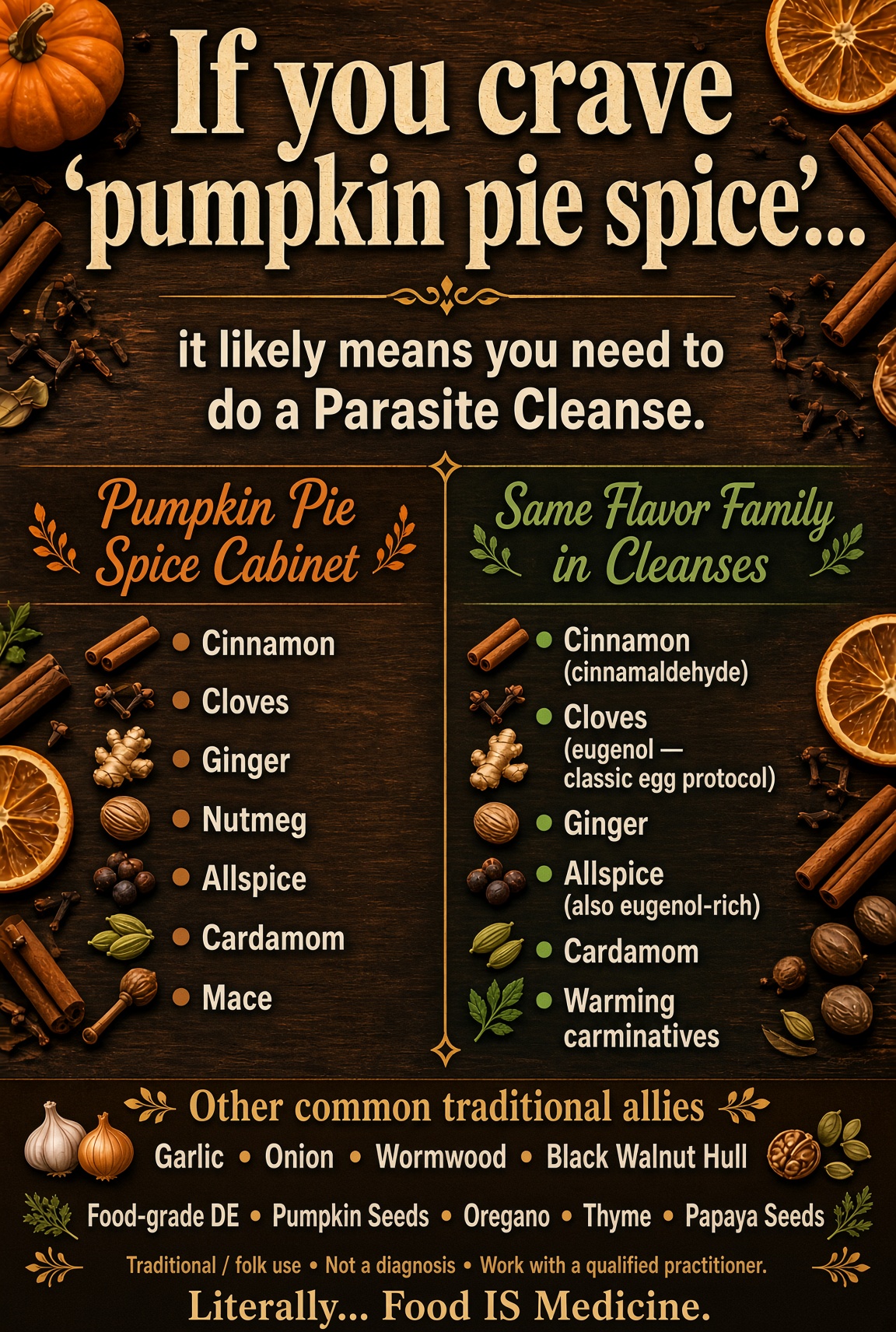
Pumpkin pie spice is a warming-spice blend — cinnamon, clove, ginger, and friends — that overlaps with plants used in traditional parasite protocols. Food is medicine. Cravings are signals.
What is actually in the jar
A classic homemade pumpkin pie spice blend is some version of this:
- Cinnamon — the backbone; most grocery cinnamon is cassia
- Ginger
- Nutmeg
- Allspice
- Cloves
- Optional: mace (the lacy covering around the nutmeg seed) and cardamom
Allspice tastes like cinnamon, nutmeg, and clove already blended. Mace is nutmeg’s quieter cousin, and a great decongestant. Cardamom is the bright, resinous note some bakers add when they want the mix to feel “complete.”
None of that is pumpkin. It is a warming-spice chord.
The same flavor family in traditional cleanses
The overlap is not mystical. It is chemistry and kitchen habit.
Clove is the cleanest match. In the well-known three-herb protocol popularized by Hulda Clark — black walnut hull, wormwood, and clove — clove is the piece aimed at eggs and cysts. The dominant compound is eugenol. Allspice is also eugenol-rich, which is why it smells like a cousin of clove.
Cinnamon carries cinnamaldehyde. It shows up in older anthelmintic plant lists and in some commercial “parasite” formulas, usually as a supporting aromatic, not as a stand-alone protocol.
Ginger is a carminative first — it moves stagnant digestion — and it has been studied in animal and in-vitro models against several parasites. In practice I see it more as terrain support: warmer digestion, less damp stagnation, easier movement through the gut.
Cardamom is a classic digestive spice in Ayurveda. It is not a Clark-protocol herb. It is in the same warming, aromatic, carminative family as the pie blend.
Nutmeg and mace are the weakest overlap for a cleanse. They belong in the pie. They are not the workhorses of a traditional protocol.
So if you put the two cabinets side by side:
Pie cabinet: cinnamon, cloves, ginger, nutmeg, allspice, cardamom, mace
Similar notes in cleanses: cinnamon, cloves (eugenol / egg stage), ginger, allspice, cardamom, other warming carminatives
Same pantry. Different intention.
The rest of the traditional allies
The pie spices are only the part that tastes like dessert. The rest of a traditional kitchen-and-herb approach looks more like this:
- Garlic and onion — sulfur compounds, especially allicin when garlic is crushed raw
- Wormwood (Artemisia absinthium) — the bitter adult-stage herb in the classic trio; not for pregnancy, not for long unbroken use, not for anyone with a seizure history without professional guidance
- Black walnut hull — the other half of that trio; traditionally said to paralyze the parasites; green hull traditionally, juglone-containing; tree-nut allergy is a hard stop
- Food-grade diatomaceous earth — mechanical, not a spice; used by some as a “sweep” with plenty of water. It also helps chop up those little (or sometimes not so little) buggers. Never pool-grade or filter-grade
- Pumpkin seeds — this is the actual pumpkin in the story. Traditional use for intestinal worms centers on cucurbitin in the seed, not the latte. Raw or freshly ground seeds, not the candy-bowl roasted kind
- Oregano and thyme — phenolic oils (carvacrol, thymol) used as broad antimicrobial kitchen herbs
- Papaya seeds — folk use for intestinal worms; peppery, not pie-like
- Often also discussed: neem, berberine plants (goldenseal, Oregon grape, barberry), pau d’arco, coconut oil
That is a list of traditional tools, not a protocol you should copy off a meme and run unsupervised.
What a craving is — and what it is not
A craving can mean:
- You like the smell of fall and marketing is good at its job
- You are cold, depleted, or running Vata and want sweet-warm-oily food
- Digestion is sluggish and the body wants carminatives
- Blood sugar is bouncing and “pumpkin spice” is a socially acceptable dessert
- Something in the gut terrain is off, and warming aromatics feel like relief
It cannot, by itself, mean “you need a parasite cleanse.”
Parasites are real. So are overgrowths, biofilms, damp stagnation, low stomach acid, and a diet that feeds the wrong organisms. So is the wellness-internet habit of diagnosing everyone with worms because they blinked. I will not do that here.
If you have a travel history, have walked outside barefoot anywhere, unexplained iron issues, persistent gut symptoms, drank tap water, anal itching, grinding teeth at night, or a practitioner who has a reason to look — that is a conversation. It is not a cinnamon roll.
How I actually use this information
In clinic and in my own kitchen, the useful version of this idea is simple:
- Use the spices as food. Cinnamon, ginger, clove, and cardamom in real meals beat a syrup pump.
- Remember pumpkin seeds exist. If you want the plant that is actually named pumpkin and actually shows up in traditional worm protocols, eat the seeds.
- Do not freelance wormwood. Bitters that strong have a job and a limit.
- Fix terrain first when you can: sleep, blood sugar, bile flow, fiber, raw garlic if you tolerate it, less sugar, more bitter greens.
- Test or work with someone before you run a 14–30 day herbal assault on your gut flora.
I work as a Traditional Naturopath under Minnesota Statute 146A. That means education, traditional tools, and the body’s own repair — not a medical diagnosis and not a prescription. If you want help sorting whether a seasonal craving is just autumn or a sign your terrain needs attention, that is session work, not a caption.
The honest close
We turned a medicine cabinet into a seasonal flavor and then acted surprised that the body still recognizes the plants.
Pumpkin pie spice is cinnamon, clove, ginger, nutmeg, allspice, and friends. Several of those friends have a long folk history against intestinal pests. Garlic, onion, wormwood, black walnut hull, food-grade DE, pumpkin seeds, oregano, thyme, and papaya seeds fill out the older toolkit.
Crave the pie if you want the pie. Just do not pretend the jar is only dessert.
Literally… food is medicine.
Traditional and folk use. Not a diagnosis, treatment, or cure. Wormwood, black walnut, concentrated essential oils, and diatomaceous earth are not appropriate for everyone (pregnancy, nursing, young children, seizure history, tree-nut allergy, and several medications are common stop signs). Work with a qualified practitioner. This article is educational commentary from SchaOn Blodgett, CCP, BTAT, Traditional Naturopath (MN §146A), Psinergy Natural Health & Holistic Wellness, Oakdale, MN.
Awarded Top 100 Holistic Health Blogs

Order Herbs & Supplements