Colorpuncture 101: How Light Becomes a Treatment
by SchaOn Blodgett, CCP, BTAT
Last time we explored Esogetic Holistic Medicine and the core idea that your cells communicate through light. This week we zero in on the branch most people ask about when they walk through the door: Colorpuncture.
What’s actually happening in a session
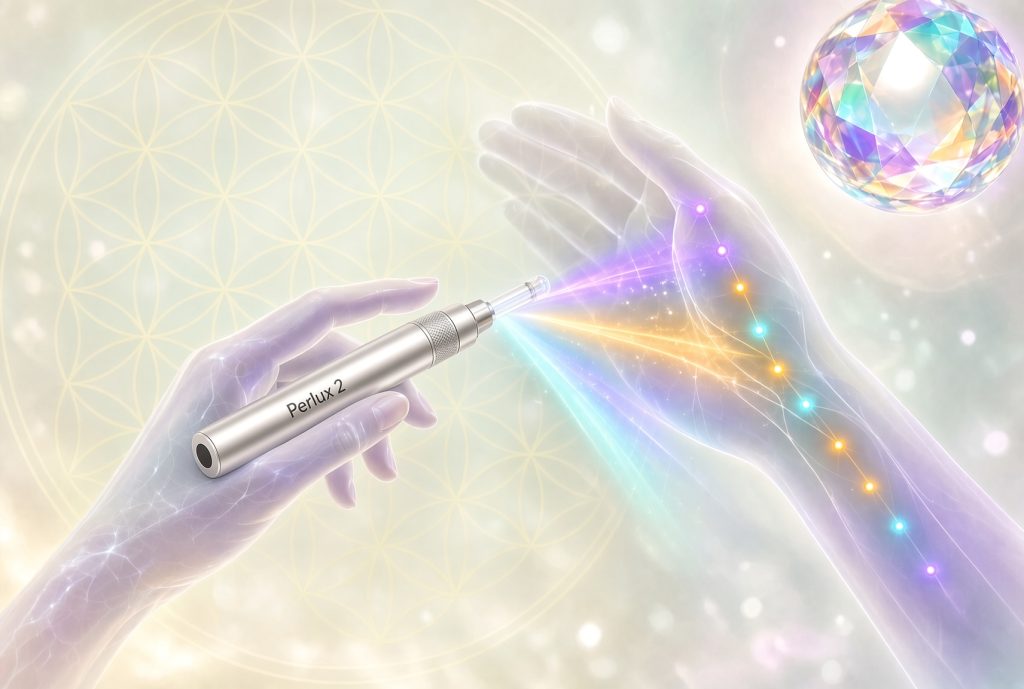
Picture a hand-held glass or quartz rod, about the size of a thick pen, with a focused light source at the tip. That is the tool. Instead of a needle, specific colors of light are applied through the rod to points on the body that largely overlap with traditional Chinese acupuncture meridians. No skin is broken. Most people feel only a gentle cool-to-warm pressure, some do report a sort-of tingling that spreads, and some even notice something happening in a different part of their body that correlates to the point.
The interesting part is why a particular color lands on a particular point.
Color is just light you can see
Visible light is a narrow band of the electromagnetic spectrum—roughly 400 to 780 nanometers—bounded by ultraviolet on one side and infrared on the other. Every color corresponds to a specific wavelength and frequency. In the Esogetics model these frequencies interact with the body’s energetic channels (the same meridians mapped for thousands of years in Chinese medicine, as well as the nadis from Ayurveda). Because the effect is understood to occur near the surface, the work pairs naturally with acupuncture and marma points rather than requiring deeper penetration.
In short, the model treats color as usable information, not decoration.
Why complementary colors matter
One of the more elegant pieces of the system draws from Goethe’s color theory. Red, yellow, and blue are treated as the primaries. From them come the complementary pairs: orange with blue, yellow with violet, and green as red’s natural complement. Colorpuncture leans heavily on these pairs. The working theory is that a point showing imbalance responds best to its opposite on the color wheel rather than more of the same frequency.
Turquoise stands apart. It has no naturally occurring complement in this system and is described in training materials as a bridge into the subconscious layers of the work—distinct from the more surface-level physical applications of the primary spectral colors.
Beyond the visible spectrum
Colorpuncture does not stop at the seven colors of the rainbow. The broader framework—sometimes called the “three pillars of light”—extends into infrared on one end and ultraviolet on the other, along with a set of “soul-spirit colors” and gray tones. Each family is associated with different depths of work: physical, emotional, and deeper still. Different families of color are understood to work at different levels of a person, not merely different parts of the body.
A concrete example I use often: the acupuncture point Large Intestine 4 (LI4) sits in the webbing between thumb and index finger. Traditional acupuncture already links it to the large intestine. In colorpuncture, constipation is addressed by applying red light at that point—the model holds that red carries the instruction to increase flow. Diarrhea is addressed with yellow at the same point, understood as supporting detoxification and release. Same point, same tool, different color, different instruction. That is the logic of the system in miniature.
- More about each color: https://www.psinergyhealth.com/natural-health-modalities/esogetics-holistic-medicine/colorpuncture/uses-of-color-frequencies/
Where this leaves you as a client
You do not need to understand wavelengths to benefit from a session. I will not quiz you. What is worth knowing is that the color choices are not arbitrary or purely aesthetic. They rest on a specific model developed through decades of clinical observation by Peter Mandel and refined since.
Colorpuncture is a complementary modality, not a replacement for medical care. The evidence base is largely empirical and observational rather than large-scale clinical trials. What keeps me practicing it is what I see change in front of me. I would rather you know that going in than oversell it.
Next in this series: Color-Sound Therapy—where these same color frequencies are translated into audio you can actually listen to.
If you are curious what a first Colorpuncture session might address for your specific situation, schedule a holistic health consultation and we will figure out where to start.
This post is for educational purposes and reflects the Esogetics/Colorpuncture model as developed by Peter Mandel. It is not a substitute for medical diagnosis or treatment. Psinergy operates under MN Statute 146A; we do not diagnose conditions or prescribe or alter medications.
Awarded Top 100 Holistic Health Blogs


Order Herbs & Supplements